


How small can computer chips get? IBM believes it has just pushed the boundaries again.
The tech giant has unveiled what it calls the world’s first chip technology capable of producing processors smaller than one nanometer.
It is a breakthrough that could supercharge the next generation of artificial intelligence.
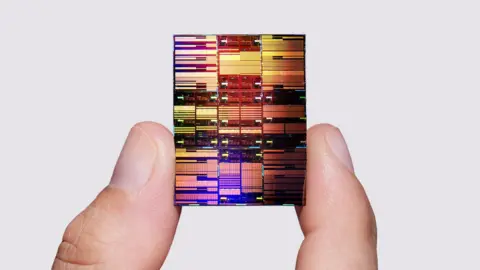
The new design features a 0.7-nanometer transistor architecture, packing nearly 100 billion transistors onto a surface no bigger than a fingernail.
That’s roughly twice the density of IBM’s 2-nanometer chip introduced in 2021.
What Makes It Different?
Instead of arranging transistors side by side, IBM developed a new 3D design called “nanostack.”
It stacks them vertically to squeeze far more computing power into the same space.
According to the company, the technology could deliver up to 50% higher performance or improve energy efficiency by as much as 70%.
It is a major advantage as AI systems demand faster, more powerful chips.
The announcement also intensifies the race with rivals such as Intel and TSMC, both working to shrink chip sizes while keeping Moore’s Law alive.
IBM’s breakthrough is still a technology demonstration rather than a commercial product.
But if it reaches mass production, it could prove that in the AI era, the biggest innovations really do come in the smallest packages.