
Imagine finding a planet that refuses to follow the cosmic “rules.”
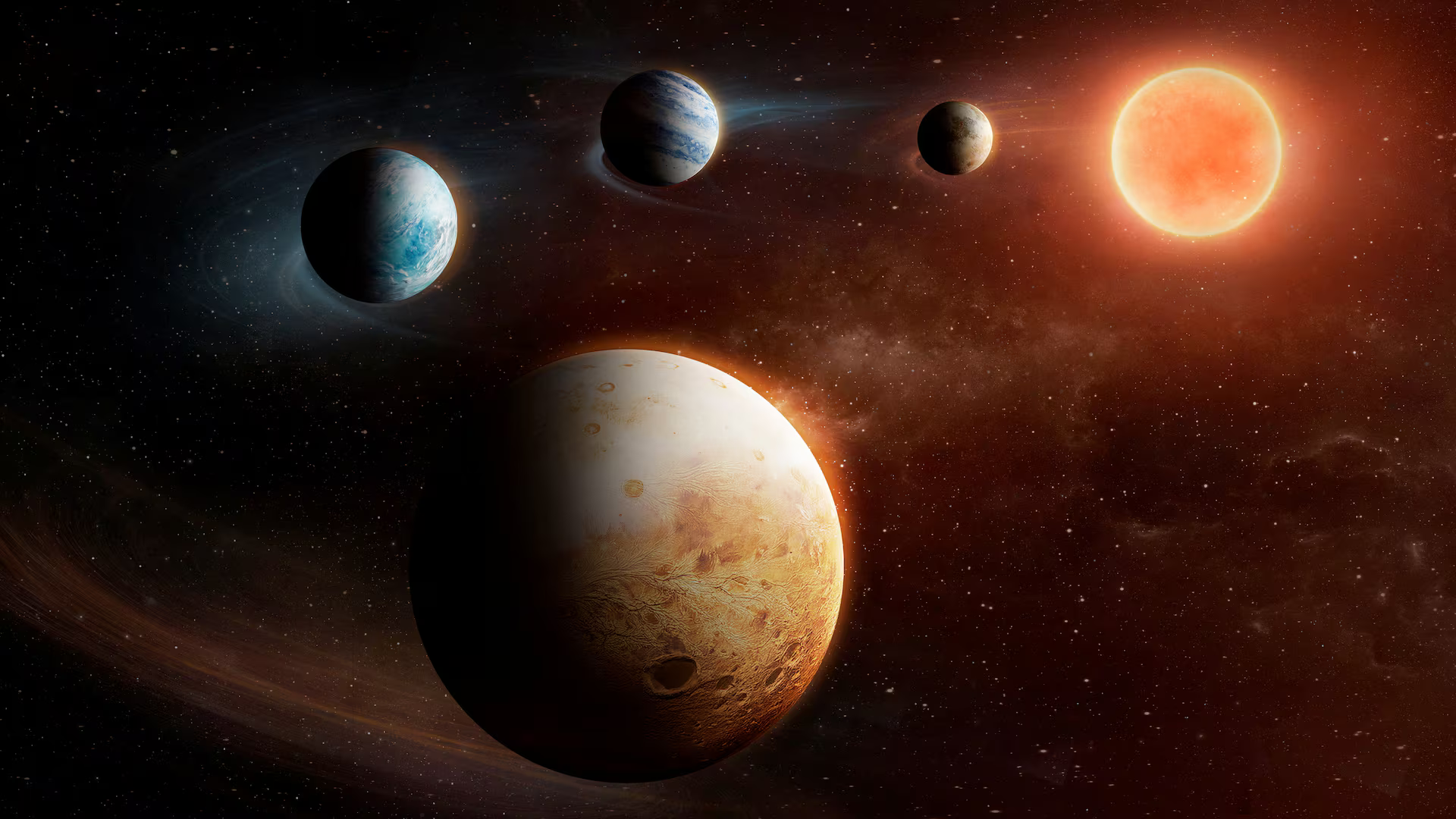
That’s exactly what astronomers have spotted 117 light-years away in a system orbiting a dim red dwarf star called LHS 1903, in the Lynx constellation.
Using the ESA Cheops, scientists identified four planets — two rocky super-Earths and two gaseous mini-Neptunes.
They are arranged in a way that turns standard planet-formation theory on its head.
“The planet-formation paradigm says planets close to their star should be small and rocky.
Farther out, gas-rich worlds dominate,” explained Thomas Wilson of the University of Warwick.
Yet here, the outermost planet, expected to be a gas giant, is rocky. Wilson calls it “a system built inside-out.”
Potentially Habitable Outlier
How did this happen? One idea: the fourth planet was a “late bloomer,” forming after its siblings had gobbled up most of the available gas.
Another theory: it may have lost a thick atmosphere after a catastrophic collision.
Not unlike how Earth’s moon formed, says Andrew Cameron of the University of St Andrews.
The kicker? This rocky outlier isn’t just quirky — it could be habitable.
With a mass nearly six times Earth’s and temperatures around 60°C, it skirts the edge of human experience.
As Wilson notes, “Future James Webb observations could reveal if life could exist there.”
So, in a universe full of cosmic rules, here’s a system that asks: who says planets have to play fair?